
The P’s of culture change
Culture change is often treated as a technical project; a plan, a set of initiatives, a communications rollout. But anyone who has led real transformation knows it is far more textured than that. Culture shifts through people, through relationships, through meaning, and through time. It is shaped by the tensions leaders must learn to navigate — not by choosing one side, but by holding both with intention.
Over the years, I’ve found myself returning to a set of paired concepts that capture these tensions. They all happen to begin with the letter P. Together, they form a practical and philosophical guide for leading culture change with clarity, steadiness, and humanity.
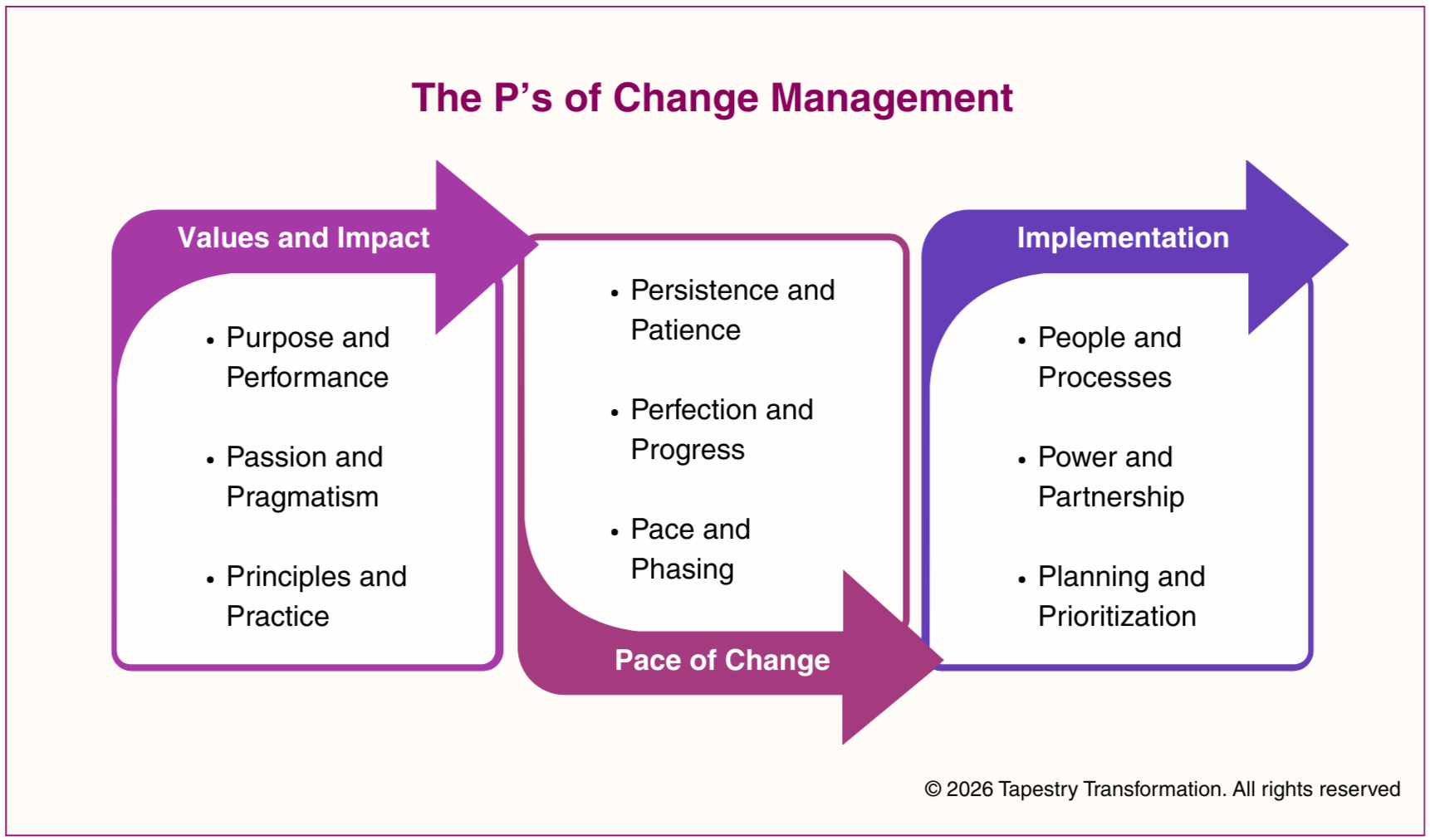
Vision and Impact
How we orient the organization toward meaning, coherence, and outcomes.
Culture change begins long before new processes or programs appear. It begins with the beliefs, intentions, and strategic clarity that shape everything that follows. These first P’s help leaders articulate not only where they’re going, but why it matters — and how to translate aspiration into action.
1 - Purpose and Performance
Purpose gives culture its soul; performance gives it its credibility. When these two drift apart, organizations lose trust and connection to the mission and the impact they seek to make. Culture change requires aligning what we believe with how we behave — ensuring that purpose is not a slogan but guides how work gets done.
2 - Passion and Pragmatism
Passion fuels energy, conviction, and the emotional commitment that makes change feel necessary, urgent, and possible. But passion alone is not enough. Pragmatism grounds the work in reality: constraints, resources, timing, and tradeoffs. Leaders must balance inspiration with implementation, ensuring that bold ideas are matched with operational discipline.
3 - Principles and Practice
Values matter only when they shape behavior. Principles articulate what we hold true; practice shows what we actually do. Culture change requires closing the gap between the two — making sure that principles are visible in decisions, interactions, processes, and everyday routines. When principles and practice align, culture becomes coherent and promotes organizational integrity.
Pace of Change
How we regulate the rhythm so change becomes manageable and sustainable.
Culture change is not a sprint or a destination. It is a rhythm that requires leaders to sense, adjust, and steward the pace so people can stay engaged, aligned, and resilient. These P’s help leaders manage the emotional and operational cadence of transformation.
4 - Persistence and Patience
Culture change takes longer than most people expect. Persistence keeps the work moving forward; patience recognizes the reality of making meaningful change. The art is knowing when to push and when to pause — when the organization needs momentum and when it needs space to learn, integrate, and recalibrate.
5 - Perfection and Progress
The pursuit of perfection can easily become a barrier to movement. Culture shifts through iteration — through learning, adjusting, and improving. Progress, even imperfect, builds credibility, capability, and confidence. Leaders who lead towards excellence but embrace progress over perfection create cultures where experimentation is possible and learning is valued.
6 - Pace and Phasing
Not everything can happen at once. Effective culture change requires sequencing; scoping and phasing the work so people can absorb it, practice it, and build capability over time. Leaders must set a pace that is ambitious enough to inspire but humane enough to be realistic, ensuring that change is not just launched but lived.
Implementation
How we operationalize culture so it becomes real, repeatable, and reinforced.
Culture becomes tangible through systems, structures, and relationships. This is where intention meets execution and where the work becomes visible in how the organization actually functions.
7 - People and Processes
Culture lives in people, but it is reinforced through processes. When the two are misaligned, culture becomes inconsistent. Sustainable change requires designing processes that support the behaviors and norms we want to see, for example in talent management, decision-making, and communication.
8 - Power and Partnership
Culture shifts when power is shared and when people feel ownership, agency, and trust. Partnership creates the conditions for participation, and participation creates the conditions for change that brings everyone along and that has the potential to lasts. Leaders must be willing to distribute power, invite diverse voices, and build coalitions that carry the work forward.
9 - Planning and Prioritization
Even the most inspiring culture vision fails without disciplined planning. Prioritization ensures that energy and resources go to what matters most, rather than being diluted across competing demands. Culture change becomes real when it is structured, resourced, and sequenced with intention.
These pairs of P’s remind us that culture change is not about choosing one side of a tension over the other. It is about learning to hold both — purpose and performance, persistence and patience, people and processes. These dualities are not obstacles; they are the work. When leaders navigate them with steadiness and clarity, culture becomes not just something we talk about, but something we live.
Prefer a printable version? Download the PDF here
If your organization is navigating culture change, consider how these P’s show up and how you engage with them. If you'd like to explore them together, connect with us here.