
The Tapestry Approach
A Framework for Values‑Led, Human‑Centered Organizational Transformation
Organizations as Living Tapestries
Organizations are like tapestries—woven from countless threads of people, processes, structures, and cultural norms. When change is introduced in only one part of the tapestry, the rest of the fabric can strain, resist, or remain misaligned. The Tapestry approach recognizes this interconnectedness and intentionally weaves together multiple change initiatives to create stronger, more coherent, and sustainable transformation.
This approach is grounded in values, centered around people, and designed to align strategy, culture, and operations. It moves organizations from a patchwork of isolated efforts to an integrated, purpose-driven transformation strategy.
Designing change with this level of intention requires more than strong plans and well-executed steps. It calls for a shared philosophy that anchors the work and ensures the process itself reflects the culture an organization seeks to create. Achieving this kind of coherence demands more than traditional change management mechanics—it requires a disciplined set of guiding principles that shape decisions, behaviors, and engagement along the way.
These principles help weave integrity, alignment, and humanity into every stage of the journey, ensuring that the threads of the process reflect the threads of the future culture.
The Cultural Patterns That Shape Organizational Life
Across organizations, sectors, and geographies, certain patterns consistently emerge. These patterns are not necessarily signs of dysfunction but can give us helpful insights as we design and implement change. They reveal where alignment is fraying, where values are not yet embodied, and where leadership is being asked to hold more than any one person or team can carry alone.
1. Parallel Realities
Leaders and staff often experience the organization in fundamentally different ways. Leaders see constraints, risks, and strategic trade-offs. Staff see lived experience, cultural gaps, and the human impact of decisions. Both perspectives are valid—and both are incomplete on their own.
2. Values Without Visibility
Many organizations have strong, aspirational values. But values that live only in statements or slide decks cannot guide behavior. When values are not embedded in behavior, processes, decision-making, communication, and leadership practice, they lose their power to shape culture.
3. Change Fatigue
Mission-driven organizations often operate in a state of continuous change; new strategies, new priorities, new external developments, new leadership, new structures. Without strategic clarity for purposeful transformation and coherence across initiatives, people can experience change as fragmentation and inefficiency rather than meaningful progress.
4. Unspoken Tensions
Every organization holds tensions: between global and local needs, between speed and engagement, between historic legacy and future innovation, between ideals and constraints. When these tensions remain unspoken, they can become barriers to trust and alignment. But we can foster dialectical mindsets (both/and thinking) and skills to navigate inherent complexity when we transparently and productively engage with them.
These patterns are not problems to fix—they are invitations to lead differently.
The Seven Principles That Shape Meaningful Transformation
Across two decades of work in global, mission-driven organizations, seven principles have consistently emerged as the foundation for sustainable, human-centered change. These principles are not prescriptions; they are approaches that can enable organizations to transform with integrity.
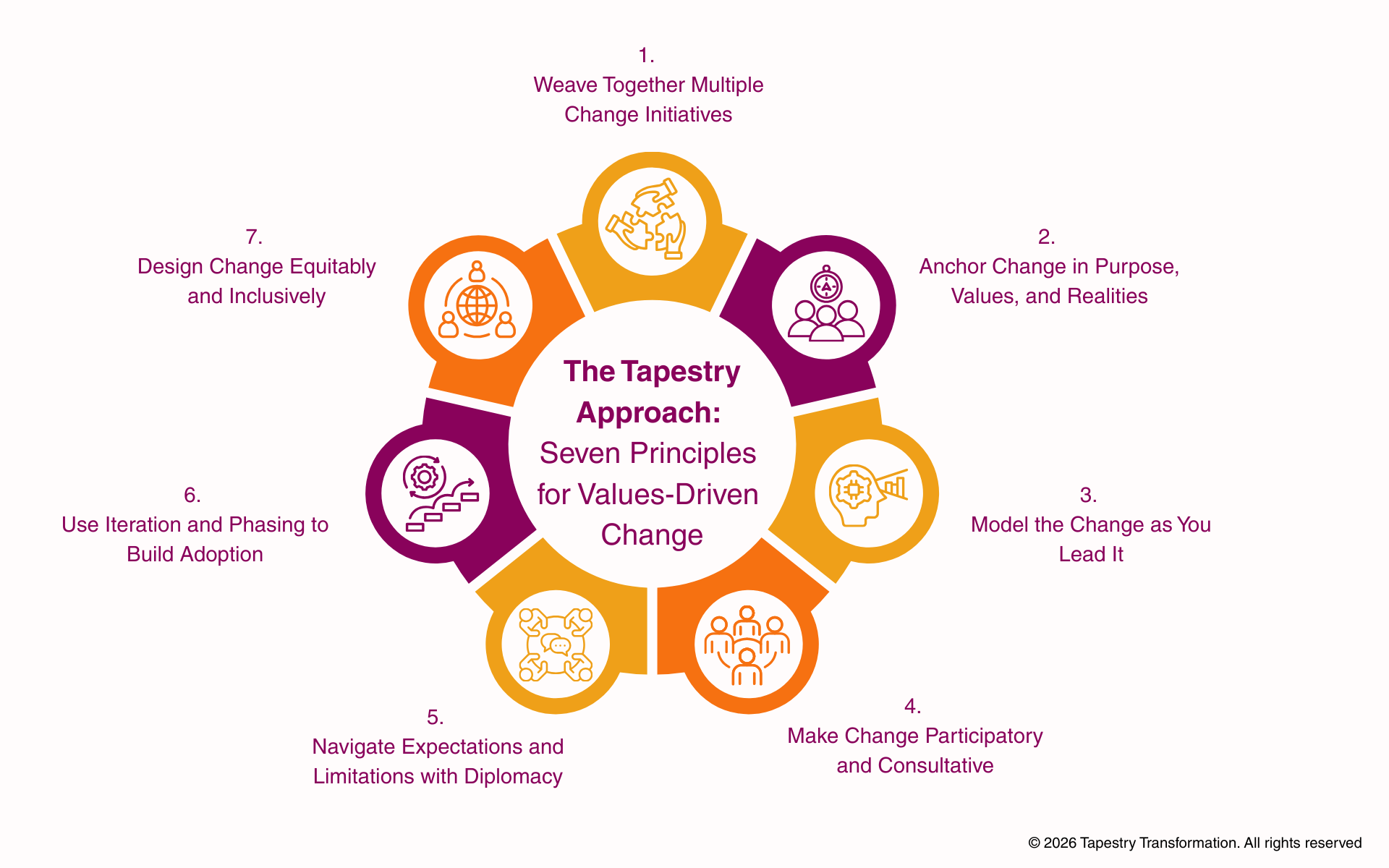
Principle 1: Weave Together Multiple Change Initiatives
Organizations rarely experience change in isolation. New systems, cultural shifts, strategic priorities, external developments, and operational improvements often unfold simultaneously. The tapestry approach intentionally connects these threads and finds synergy among them. Rather than afterthoughts or complications, we inherently incorporate them in the design and implementation of transformation efforts where possible.
Weaving initiatives together:
Grounds each change in broader organizational values and priorities
Helps people understand the purpose and context of the change
·Creates synergy across efforts, increasing impact and reducing duplication
Makes resource use more efficient and strategic
This integrated approach reinforces the organization's values and builds coherence across efforts.
Example - A monitoring and evaluation (MEL) initiative becomes more effective when connected to cross-team information flow, wellbeing, DEI principles, strategic planning, and donor reporting—rather than treated as a separate project.
Way Forward - Build Coherence Across Initiatives: Map the threads, identify overlaps, and intentionally align work so people experience change as integrated rather than fragmented.
Principle 2: Anchor Change in Purpose, Values, and Organizational Realities
Every change initiative should begin with clarity about:
The purpose of the change
The pain points it addresses
The values it advances
The organizational realities it must navigate
When the North Star is clear, organizations can be flexible about the path to get there. Purpose-driven change is both principled and pragmatic. It clearly and transparently communicates "the why" in a way that people can connect to, even if they may not always agree with the change itself.
Example - A shift away from global expansion toward deeper regional focus initially sparked disagreement. But when leadership articulated the rationale—risk management, sustainability, staff support, relationship-building, and carbon reduction—staff moved from critics to partners.
Way Forward -Make Values Visible: Embed values in decisions, behaviors, communication, and trade-offs so people can see the alignment between purpose and practice.
Principle 3: Model the Change as You Lead It
Every change initiative carries underlying values such as trust, collaboration, equity, clarity, and growth. These values should be visible not only in the outcome but in the way the change is designed and implemented.
Demonstrating values in the process:
Builds alignment between intention and action
Helps people experience and practice the change before it is fully implemented
Creates shared understanding of what the change is meant to achieve
Reduces skepticism and increases trust
Example - While developing systems to increase transparency, leaders shared regular updates about the process itself—modeling the transparency they sought to embed.
Way forward -Practice the Behaviors You Expect to See: Make the desired change objective visible in your own actions. Demonstrate transparency, consistency, and follow‑through; share your thinking openly; and model the collaboration, clarity, and inclusion the change is meant to advance.
Principle 4: Make Change Participatory and Consultative
Change is most effective when people are not merely recipients of it but collaborators in shaping it. Participation turns change from something done to people into something built with them.
A participatory approach:
Engages leaders, managers, staff, and stakeholder groups
Reduces the distance between leadership and staff
Builds early buy-in and shared ownership
Improves the quality and relevance of the final design
Example - A new global staff and leadership advisory council was designed through broad consultation, especially with staff who are often marginalized due to function, location, language, or seniority. The result was more inclusive, more effective, and more widely supported.
Way Forward -Engage People Across the System: Invite meaningful participation from leaders, managers, staff, and stakeholders so people help shape the change rather than receive it.
Principle 5: Navigate Expectations and Limitations with Diplomacy
Change management often requires bridging the gap between different perspectives, needs, and realities. One common tension is between leaders focused on constraints and staff focused on ideals.
Effective change leadership requires diplomacy to:
Help leaders expand their sense of possibility
Help staff understand practical constraints
Build empathy, shared understanding, and realistic expectations
Create solutions that most people can support—even if not everyone gets everything they want
Example - During strategic planning, staff urged leadership to prioritize racial justice and DEI. Leadership initially resisted, citing constraints. Through facilitated dialogue, both groups surfaced assumptions, clarified priorities, and co-created a path forward.
Way Forward -Lead With Diplomacy: Hold complexity with clarity and care. Foster relationships. Bridge perspectives. Expand possibility for leaders while grounding expectations for staff.
Principle 6: Use Iteration and Phasing to Build Adoption
Meaningful change rarely lands perfectly on the first try. Iteration is essential and should be built into the process from the start.
A phased approach:
Sets realistic expectations for early adoption
Creates space to learn from what works and what doesn't
Allows for refinement before broader rollout
Builds confidence and competence over time
Example - A new performance management approach was implemented in four phases. Though slower than leadership preferred, adoption reached 95% by year-end—exceeding expectations.
Way Forward -Sequence For Success: Use phased implementation and learning loops to ensure people have the clarity, support, and time they need to adopt new ways of working with confidence.
Principle 7: Design Change Equitably and Inclusively
Change is not experienced the same way across identities, roles, locations, or levels of power. Effective transformation recognizes the diversity of lived experiences within an organization and supports people from their starting point toward a shared future. When leaders understand how different communities experience change, they can design processes that are equitable, accessible, and responsive to real needs.
This includes:
Recognizing variation in readiness, access, and trust across communities
Tailoring support, communication, and timelines to meet people where they are
Embedding equity into both the design and delivery of change
Example -During a global systems rollout, leaders realized that smaller, under‑resourced offices were struggling more than headquarters due to time zones, language, and uneven access to training. Instead of pushing a uniform plan, the organization adapted its approach—offering localized training, adjusting timelines, and tailoring support. Meeting each community where they were strengthened adoption and trust across the organization.
Way Forward: Support Diverse Needs: Recognize that people and teams begin change from different places based on identity, role, power, geography, and lived experience. Tailor communication, support, and expectations so each community has what it needs to participate fully and move toward the shared vision.
Case Studies: What These Principles Look Like in Practice
These examples illustrate how the principles come to life in real organizational contexts.
Case Study 1: “Culture Eats Strategy for Breakfast”
A global nonprofit unveiled an ambitious new strategy centered on cross‑regional collaboration and shared impact. But the culture still rewarded autonomy, speed, and siloed decision‑making. Staff understood the strategy intellectually but couldn’t see themselves in it. Through a participatory strategy learning journey and a culture activation process, the organization clarified shared behaviors, strengthened leadership alignment, and created a common language for collaboration. As a result, the strategy helped to create cohesion rather than conflict.
Case Study 2: Co-Creating Values Practice
An organization deeply committed to equity and justice struggled to translate those commitments into operational choices. Teams interpreted values differently, leading to conflict and confusion. By co‑creating a values‑driven decision framework, the organization established clear criteria, surfaced trade‑offs openly, and built a more coherent approach to decision‑making.
Case Study 3: Waking up to Change Fatigue
A human rights institution was navigating multiple transformations—new systems, new structures, new leadership expectations. Staff felt exhausted and skeptical. Leaders felt pressure to move quickly. A phased, iterative change strategy aligned initiatives, clarified roles, and created space for learning. Over time, change shifted from something overwhelming to something intentional and manageable.
The Tapestry Approach in Practice
Tapestry Transformation brings together:
Strategy and culture
People and processes
Values and organizational effectiveness
Technical change and human change
It recognizes that:
Change is never just technical
Culture is always part of the equation
People must be brought along with care, clarity, and intention
Values must be visible in both process and outcome
This approach strengthens each initiative—and the organizational fabric as a whole.
Tapestry transformation is a holistic, values-forward approach to organizational change. It weaves together multiple initiatives, aligns them with purpose and values, and engages people in meaningful ways. It is strategic, human-centered, iterative, and grounded in the belief that organizations thrive when their people, processes, and culture move together.
By weaving the threads of change into a cohesive tapestry, organizations create transformation that is not only effective but enduring—built from the inside out and sustained by shared ownership, clarity, and purpose.
Prefer a printable version? Download the PDF here.
If your organization is navigating complexity or stepping into a new chapter, and you’re seeking a values-led approach that brings greater coherence, clarity, and alignment to your tapestry of change, connect with us here for a conversation about how we might weave the path forward together.