
Mapping the Moment: how Understanding the forces shaping diversity, equity & inclusion help us chart a way forward
EXECUTIVE SUMMARY
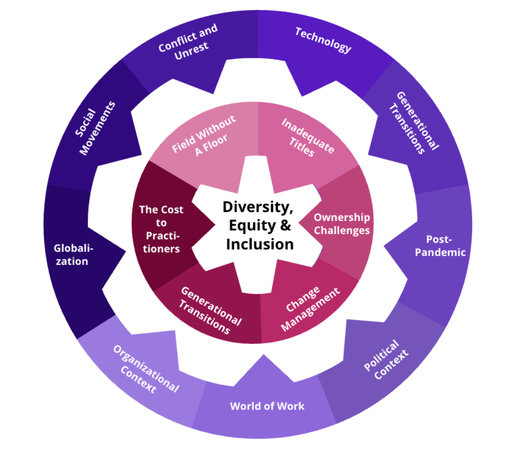
Something feels different about this moment for diversity, equity, and inclusion (DEI). The political backlash is real and consequential, and the field itself has been struggling. But reading the moment as a backlash, or as any single attack, mistakes the loudest force for the whole. What actually makes it so hard is convergence, and it presses from two directions at once. From the outside in, a set of external forces is bearing down on the work all at the same time: political pressure, economic uncertainty, a changing world of work, generational transition, technological disruption, and organizational retrenchment.
From the inside out, the field’s own long-unresolved questions are surfacing in the very same moment: a field that never built a shared floor, work that was never sufficiently captured in a title, a generational handoff underway, and the exhaustion of the people who carry it. No one was going to reason their way easily through this many realities at once. The overwhelm so many people feel is not noise around the story. It is the story, and it lands both professionally and personally on anyone who cares about this work.
Converging Forces
Two things about this field explain why the outside and the inside meet so forcefully here. The first is that DEI is unusually porous to the world around it. More than most organizational functions, it takes in wider societal tensions directly into its daily practice, which is both the source of its power and the reason the outside impacts the inside so readily. The second is that it never built a floor. Unlike finance or IT or HR, the field grew without a shared baseline of definition, practice, or language, so it meets this pressure with little solid foundation underneath it. The plurality that makes the work responsive across organizations, sectors, and geographies is the same quality that left it without a shared floor, and an easier target once the pressure came. Almost every difficulty in this moment traces back to one or both of these two things.
From Default to Design
Organizations are already responding very differently, and the difference is telling. Some are not adapting enough; others are retreating well beyond what the moment requires. When risk, frustration, and uncertainty are driving decisions, seeing the landscape clearly is what separates a deliberate choice from a costly reflex. We have watched that reflex cost organizations their trust and morale, their effectiveness and sustainability, their reputation and revenue, and the people charged with leading this work.
This paper is our attempt to make the convergence easier to see, so we can move through it and design what comes next with more intention. We are not proposing a new framework or a different name for the work; several thoughtful ideas have recently been developed, and the fact that so many have emerged at once is itself part of what we are describing. What we offer instead is a map rather than a model: the forces converging on this work laid out so each becomes possible to see and to act on from your own role, organization, and context.
The map also turns inward, to the field itself. Rather than treat its fragmentation as a flaw to correct, we name what is actually inside the work: a range of distinct functions, orientations, and capabilities carried all along by many kinds of people and rarely made visible. Seen together, the sprawl reads differently. It becomes an ecosystem whose parts are complementary, and whose differentiation can be designed on purpose rather than left to accident. This is the turn from a field without a floor to one that knows itself well enough to defend and define itself.
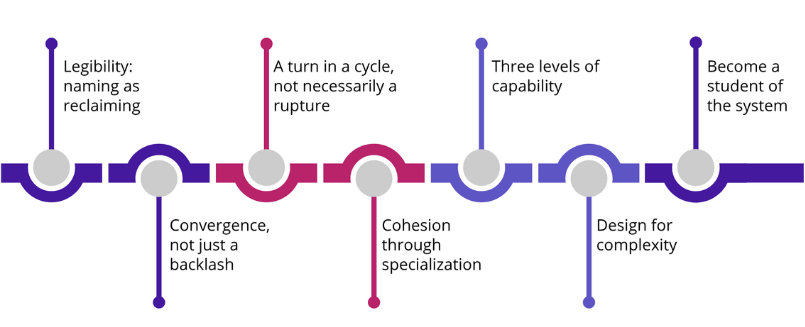
From the map, seven threads surfaced again and again. They are less conclusions than ways of seeing, and each works at two levels: a mindset shift for now, a way of understanding this moment so we can relate to it differently, and an element of a blueprint for later, a consideration for what the field could deliberately become.
Legibility: naming as reclaiming. When we can name the work plainly, what it is and what is lost when it is cut, we begin to reclaim it; over time, a more legible field is one its critics can no longer define.
Convergence, not just a backlash. Recognize the full set of forces converging in your context rather than bracing against one enemy; design what comes next to account for all of them, not a single one.
A turn in a cycle, not a rupture. This field has changed forms before, so trade panic for perspective; design the next phase as a deliberate transition rather than a final arrival.
Cohesion through specialization. See the field’s many roles and orientations as complementary rather than competing; specialize on purpose, so differentiation becomes intentional gradient rather than accidental sprawl.
Three levels of capability. Get honest about what everyone in your workplace needs, what each organizational function needs, and what practitioners need; build all three deliberately, holding shared ownership and differentiated expertise together.
Design for complexity. Move from binary to degree and hold gains and shortfalls at once; design for the complexity rather than around it.
Become a student of the system. Study the organizational system before acting in it, since understanding it is not the same as accepting it; make analyzing the landscape and doing the work a single practice, so the next phase is shaped rather than merely survived.
A shared thread runs underneath all seven: a progression from default, to discerning, to deliberate design. So much of where the field finds itself, its fragmentation, its exposure, the weight that fell on too few people, happened by default rather than by intention. Seeing the whole and its parts with curiosity rather than judgment is how we find this moment’s openings, not only its threats, and begin to shape deliberately what was left to chance.
We do not know what this field will be called in five or ten years, and we are less concerned with preserving an acronym than with whether the underlying work, and the purpose beneath it, becomes more strategic, durable, human, and effective. The questions it carries, who an organization is for, how opportunity moves through it, whether people can do their best work and be treated fairly, do not disappear when a title does. This can be a moment of contraction. It can also be one of maturation. What comes next is not simply happening to us. It is ours to shape.
We wrote this to make a hard moment easier to see, and we're still making sense of it ourselves. We'd love to hear what you saw, what you think we we missed, and where you'd want to take this next. We know it can be overwhelming, so we also made some simple, free worksheets to help you orient yourself in this moment. You can share your thoughts and request the worksheets via this survey.