
The Echo Effect
How Mission Intensity Shapes Organizations, and How to Design for it on Purpose
Executive Summary
Most of us have felt the Echo Effect before we had a name for it. We feel it in the friction between how committed we are and how exhausted we feel. In values that unite us on Monday and divide us on Wednesday. Or in the way scarcity makes us resourceful and competitive in the same breath. It shows up in how professional disagreements become interpersonal conflict that is charged with deeply held beliefs. Or how staff uses activism tactics they deploy externally, internally with peers and leaders, and how leaders respond like advocacy targets would.
This is the Echo Effect. The same forces that make mission-driven work possible, urgency, moral clarity, emotional investment, deep personal conviction, are the same forces that generate its most persistent internal tensions. An organization's greatest strength and its greatest challenge are often the same thing.
Internal ways of working are not simply infrastructure for the mission. They are an extension of it. How an organization creates its culture, makes its decisions, and holds its tensions is part of how its impact is achieved, or undermined. And the moment sharpens it further: intensifying scrutiny, a backlash against stated values, generational expectations, blurring lines between sectors, and the arrival of AI are each raising mission intensity and widening the gap between what organizations believe and how it feels to work inside of them.
This is not the first attempt to make sense of what happens inside mission-driven organizations. Earlier thinkers saw that the external issues an organization existed to address were recreated internally. The Echo Effect widens that lens, because the same patterns surface even when the internal strain has nothing to do with the external cause. What generates them is the intensity itself, whatever the mission happens to be. the Echo Effect is not just a diagnosis, but an invitation to see our organizations differently and design them to work with the Echo rather than against it.
The four areas where the echo tends to concentrate are the nature of the work, where intensity drives urgency and burnout; values alignment, where the gap between stated and lived values erodes culture and credibility; power and trust, where trust goes deeper than the professional and attunement to power is higher, because both are the work itself; and operating conditions, where scarcity and other constraints shape culture as powerfully as any value statement.
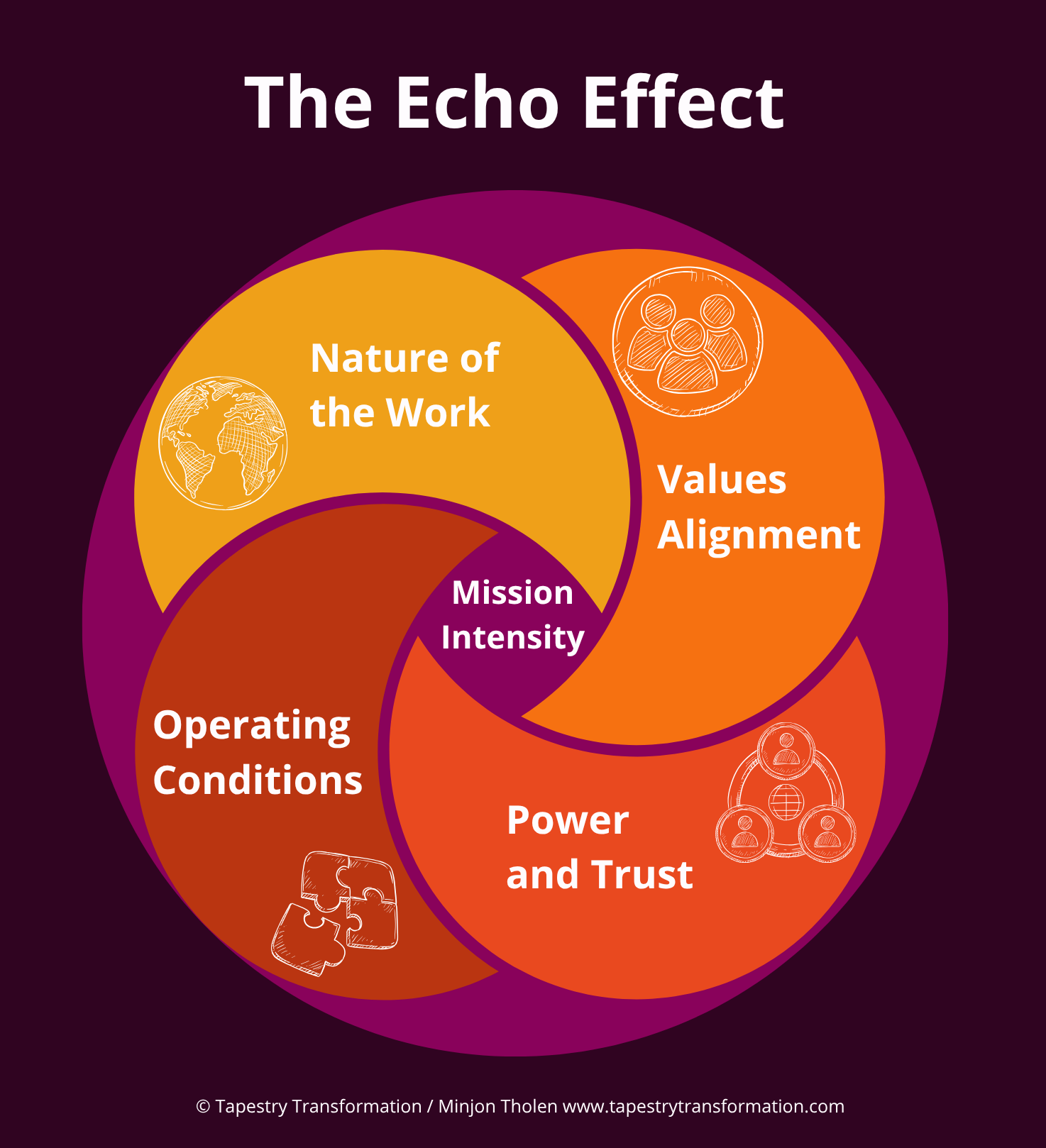
Each of these dynamics is familiar on its own, and most organizations name and manage them one at a time. What is rarely recognized is that they are versions of a shared force that compound one another. Exhaustion makes the values gaps harder to face; the gaps erode trust; a trust deficit makes every question of power feel sharper; and infrastructure projects become value tests. Pull on any one thread and the others move. Seeing them as one force rather than separate fires is what turns a pile of familiar frustrations into something an organization can work with.
The Echo Effect is not a flaw to eliminate. Mission intensity is the most renewable resource organizations have, and the question is not how to reduce it, but where it goes. Recognizing the dynamic is what helps to create some distance, gain perspective, and take a breath, so that we are not subject to the Echo Effect by default, but design for it with intention.
And it is a practice, not only a diagnosis. An organization asks its teams to plan their work at eighty percent of anticipated capacity to help with workload management and to create space for the things it said it valued, like collaboration, management, development, adaptation, and rest and resilience. Another organization, in a charged moment when staff pressure had turned inward and leaders felt under siege, recognized the dynamic in the room, turning an entrenched conflict into a workable situation with a productive solution. And yet another created new collaboration structures and decision-making and resource allocation protocols with its key stakeholders where both the process and the outcome improved trust. When designed well, the same energy that strains an organization by default becomes a source of clarity, cohesion, and effectiveness.
Leaving it unattended has a cost, from an organization that is simply less than the sum of its parts to one whose strain, turnover, and lost credibility compound until the work itself is at risk. Engaging with it differently offers us something else. So much of what people carry, the exhaustion, the friction, the sense of falling short, gets absorbed as personal or organizational failure, blaming ourselves and others, and consuming energy that otherwise could go to advancing the mission. Seeing the Echo Effect for what it is loosens this grip: the strain is often structural, predictable, and shared, and it comes with the territory of caring this much about something that is bigger than ourselves. When we can approach this with curiosity, we can be more deliberate, joyful, effective, and sustainable in working towards the mission that drew us to this work in the first place.
The individual parts of this paper are not intended to be a revelation. You have likely felt some of this even if you didn’t have a name for it, and that is the point. The intention is to show all of this together in one place and make the familiar legible, so it can be seen clearly, talked about honestly, and designed for on purpose, rather than endured. Because in the end, how a mission-driven organization works on the inside on what it is trying to build on the outside is not a departure from the mission. It is its fullest expression.
Seeing the Echo Effect in your organization? Let's talk about designing for it.