
LEAD BETWEEN THE Lines: Understanding the invisible labor of leadership
INTRODUCTION
The Work Between the Lines
Leadership today is defined as much by what is unseen as by what is visible. The most consequential work leaders do rarely appears in a job description or competency model. It lives between the lines — in the emotional, relational, interpretive, strategic, and internal labor that holds teams together and keeps organizations moving through change and uncertainty. The leaders I work with rarely struggle because they lack skill, intelligence, or commitment. They struggle because they are carrying an enormous amount of this invisible labor, work that is essential to organizational functioning yet almost never adequately named, resourced, or structurally supported.
What Exhaustion Really Comes From
One morning, a senior leader walked into our meeting looking exhausted. Not because of the strategy review she had just led or the board meeting she was preparing for, but because of everything in between: the conflict she mediated between two directors, the emotional fallout from a reorganization, the hours spent translating a vague executive directive into something her team could understand, and the constant work of keeping her own frustration from spilling into the room.
“It’s only Tuesday,” she said, “but it’s already been a long week. I feel like I’m constantly busy but not making progress on the things that are actually in my job description.”
Every leader I’ve worked with has said some version of this. They feel overwhelmed not just by the volume of work, but by the context in which that work gets done — the cultural dynamics, structural gaps, interpersonal tensions, and identity‑based biases that shape their daily reality. Their organizational cultures, systems, processes, and ways of working don’t support them or their teams sufficiently, which is why this work matters.
Leadership isn’t broken. Our understanding of leadership doesn’t yet encompass its full complexity.
A Constellation of Roles, Not a List of Tasks
We often talk about leadership as a set of discrete skills or tasks, when in reality it is a system of roles — relational, interpretive, generative, strategic, and internal — that leaders move through every day. These roles are the connective tissue of leadership, the work that happens between the lines of formal responsibilities.
Because organizations rarely recognize or name these roles, they also fail to prepare leaders for them or support them in navigating them. And when these roles stay invisible, organizations miss the chance to proactively and constructively leverage them — in day‑to‑day leadership and especially during times of change.
This is also why leadership development so often falls short. It’s not just the programs or competency models — it’s the leadership structures, cultures, and expectations that fail to account for the complexity leaders are actually navigating. This gap is why so many organizations struggle with effective, values‑aligned leadership, and why leaders feel overwhelmed even when they are technically “high performing.”
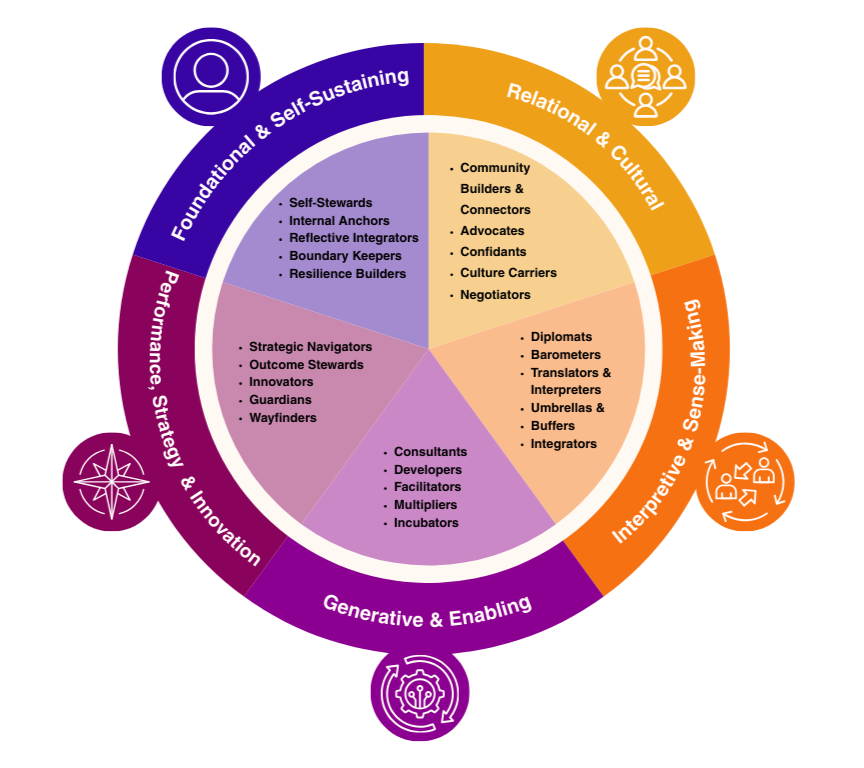
To be clear, not every leader plays every role at all times. The roles they take on depend on their organization, function, seniority, culture, identity, strengths, leadership philosophy, and the situation at hand. In this paper, leadership refers to all levels — from first‑time managers to senior executives — and these dimensions also show up for staff who are not formal managers but serve as informal leaders, such as ERG leads, working group chairs, or highly trusted, visible individual contributors.
Understanding these roles is also essential for advancing diversity, equity, and inclusion. While these leadership dimensions can show up for any leader, they are often inequitably distributed. Invisible and emotional labor is disproportionately expected of women — particularly women of color — and leaders from other underrepresented communities. This framework helps illuminate the biases and structural dynamics that contribute to disparities in leadership expectations, advancement, retention, performance management, wellbeing, and effectiveness.
Importantly, these roles are not only sources of strain; they are also sources of deep meaning. Many leaders take pride in being the person others turn to for clarity, steadiness, or connection. The work of interpreting, supporting, and guiding others can be profoundly fulfilling when it is acknowledged, supported, and balanced with the rest of their responsibilities.
This paper introduces a framework for understanding leadership — a constellation of roles that reflects the true multiplicity of what leaders carry and connects directly to how teams feel cared for and how organizations shape culture, strategy, and change. It moves beyond technical and tactical responsibilities to illuminate the human dynamics that define the lived experience of leadership. It offers a shared language for the invisible labor leaders perform and practical ways to apply this model across organizational life.
The Hidden Complexity of Leadership
Leadership is not a single function, nor is it a tidy list of competencies. Leaders often move through a dynamic constellation of roles that draw on emotional labor, cognitive labor, relational intelligence, strategic clarity, and internal steadiness—often all within the same hour.
Leaders are asked to:
Hold the emotional center of their teams — steadying anxiety, absorbing uncertainty, and creating psychological safety even when they themselves feel stretched.
Translate ambiguity into clarity people can act on — turning incomplete, shifting, or conflicting information into direction that feels coherent and trustworthy.
Grow people while buffering them from organizational turbulence — coaching, advocating, and developing talent in environments that are often unclear or unstable.
Drive progress while navigating competing priorities, personalities, and pressures — balancing ambition, constraints, and relational dynamics, not just “delivering results.”
Sustain their own capacity while carrying the weight of everyone else’s needs — managing their energy, boundaries, and internal steadiness so they can keep showing up with integrity.
And they do all of this while absorbing the emotional and psychological impact of the world around them: conflict, racism, political extremism, economic uncertainty, climate crises, and the personal challenges they and their staff carry into the workplace. These realities shape how teams feel and function, and whether organizations acknowledge them or not, leaders are often grappling with leading through turbulence outside of their control.
Leaders often become the first line of support, helping people process anxiety, fear, grief, anger, or polarization while managing their own internal responses. They are expected to create steadiness in moments of collective instability, hold space for conversations that are emotionally charged or politically sensitive, and maintain cohesion when external forces strain relationships and trust.
This layer of labor is rarely named, yet it profoundly shapes how leaders show up, what their teams need from them, and the emotional weight they carry every day.
These complexities often don’t explicitly appear in a job description, yet they determine whether teams feel supported, whether culture thrives, whether strategy lands, and whether change takes root. What looks like a single role from the outside is, in reality, a dynamic interplay of responsibilities that leaders navigate moment to moment. Leaders don’t experience their work as a checklist—they experience it as a multidimensional system of visible and invisible labor.
This framework brings that full landscape into view, offering a more holistic and human‑centered way to understand leadership. It gives organizations a clearer picture of what leadership actually requires—and a more intentional way to support the people doing it.
The Five Dimensions of Leadership
1. Relational & Cultural Leadership
How leaders build trust, connection, and the social fabric of their teams and the organization.
Relational leadership is the foundation of culture. It determines how people feel, how they collaborate, and whether they trust the organization enough to take risks, speak honestly, and stay engaged. Roles within this dimension include:

Community Builders & Connectors — cultivating belonging, trust, and collaboration by connecting people and work across difference.
Culture Carriers — embodying and reinforcing the values, norms, and behaviors that shape how the organization lives its mission.
Confidants — holding space for honest, grounded, and vulnerable conversations that strengthen trust.
Negotiators & Mediators — navigating conflict and competing needs with fairness, clarity, and relational intelligence.
Advocates — elevating underrepresented voices and ensuring people and perspectives receive the visibility they deserve.
Leaders frequently invest heavily in fostering community for others, yet find it difficult to access that same support for themselves. They become the go‑to person for processing and problem‑solving, but often lack someone to turn to in return. This imbalance can erode their wellbeing, hinder collaboration, and weaken their sense of connection, ultimately leading to isolation, burnout, and performance challenges.
Yet this work is also one of the most vital and generative parts of leadership: the ability to cultivate trust, strengthen relationships, and create the conditions where people feel grounded and able to do their best work. When this role is shared, supported, and held within a healthy system, it becomes a powerful force for cohesion and collective resilience rather than a source of depletion.
The DEI dimension of relational labor
This emotional and relational labor is disproportionately placed on leaders from underrepresented communities—particularly women and people of color—who are often expected to carry more of the organization’s connective and caretaking work while receiving less support, recognition, and protection in return.
At the same time, many of these leaders bring a powerful capacity to build trust, create belonging, and hold communities together in ways that strengthen the fabric of the organization. These contributions should be recognized and supported, not assumed or taken for granted, so that leaders can offer this work with sustainability and integrity rather than strain and inauthenticity.
Relational leadership during change
During moments of change, relational and emotional demands intensify. Leaders must hold space for heightened uncertainty, navigate sharper sensitivities, and sustain trust when people are most anxious and the path forward is least clear. They become the connective tissue that keeps communication honest, relationships intact, and teams grounded enough to move through disruption.
When leaders are properly supported and these roles are authentically recognized, they become powerful expressions of empathy, care, and inclusion—essential conditions for navigating change with integrity and cohesion. Without that support, the weight of this labor can deepen exhaustion, erode trust, and limit an organization’s ability to bring people along through transition.
Relational leadership is where the constellation begins—because it shapes every interaction and every team dynamic. But trust and connection alone are not enough. Leaders must also help people understand what is happening around them, which brings us to the interpretive work that turns complexity into clarity.
2. Interpretive & Sensemaking Leadership
How leaders make meaning, translate complexity, and help others understand what is happening and why.
Interpretive leadership is essential for strategy and change. Without meaning‑making, even the best strategies fail to land, and even the most necessary changes fail to take hold. Roles within this dimension include:
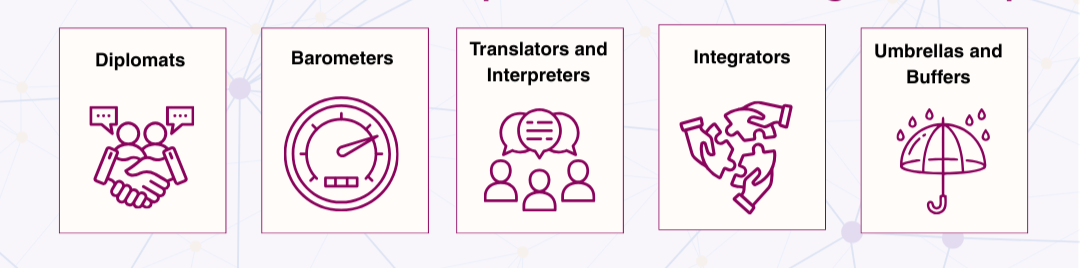
Diplomats — navigating competing truths, pressures, and expectations with steadiness, nuance, and discernment.
Barometers — detecting and anticipating emerging tensions, needs, and shifts in climate before they surface publicly.
Translators & Interpreters — turning ambiguity, decisions, and strategy into meaning people can understand, trust, and act on.
Integrators — weaving perspectives across levels, functions, and identities to create shared understanding and alignment.
Umbrellas & Buffers — filtering, contextualizing, and sequencing information so teams stay informed without becoming overwhelmed.
Leaders’ interpretive and sensemaking roles flow both downward to their teams and upward to leadership as intermediaries, navigating complex relationships with empathy and nuance. This balancing act often challenges leaders’ ability to voice their own perspectives, as they weigh competing loyalties, trust dynamics, identity considerations, and information asymmetries.
These tensions can place leaders in difficult positions that strain relationships and social capital, sometimes leading to feelings of discomfort, inauthenticity, or reduced effectiveness.
Yet interpretive leadership is also one of the most intellectually and strategically engaging aspects of the role—the work of discerning patterns, translating complexity, and helping people understand what is happening and why to foster a shared sense of purpose. When leaders are supported in this work, it becomes a powerful source of clarity, alignment, and organizational coherence.
The DEI dimension of interpretive labor
For leaders from underrepresented identities, interpretive labor often carries additional layers that others never have to consider. They are frequently expected — implicitly or explicitly — to bridge cultural gaps, anticipate how decisions will land across different communities, and navigate power structures that do not always grant equal voice, safety, or margin for error. This means they are not only interpreting organizational complexity, but also interpreting identity dynamics, bias patterns, and the unspoken rules that shape how their leadership is received.
At the same time, many bring a sharpened ability to read context, surface unspoken dynamics, and illuminate perspectives that might otherwise be overlooked. These capacities are not necessarily innate; they are often the result of lived experience — years of navigating environments where attunement, pattern recognition, and cultural fluency were necessary for credibility, safety, or advancement. When recognized and supported, these strengths significantly enhance an organization’s ability to make sense of complexity with integrity, nuance, and a broader field of vision.
Interpretive leadership during change
Sensemaking and interpretation become especially critical during moments of change. Leaders must simultaneously represent the organization’s direction to their teams and surface honest, bottom‑up insights about how the change is being experienced. This dual flow of meaning—downward for clarity and alignment, upward for truth‑telling and course correction—determines whether change is designed well and whether people can actually come along with it.
When these interpretive roles are supported and intentionally leveraged, they become powerful drivers of trust, alignment, and adaptive decision‑making. When they are unsupported, they can just as easily create confusion, resistance, and fragmentation.
Interpretive leadership sets the stage for movement, growth, and shared ownership—the generative dimension that fuels progress and possibility.
3. Generative & Enabling Leadership
How leaders create conditions for growth, movement, and shared ownership.
If relational leadership builds the social fabric and interpretive leadership makes sense of complexity, generative leadership is what turns possibility into momentum. It is the dimension where leaders help ideas take shape, help people grow, and help teams move forward with clarity and shared ownership.
Generative leadership fuels innovation, learning, and organizational evolution. It ensures that people and ideas have the conditions they need to grow—not just in theory, but in practice. Roles within this dimension include:
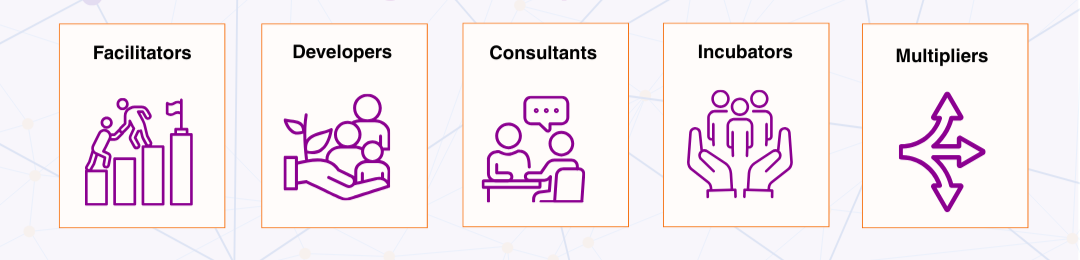
Facilitators — guiding processes and conversations that move work forward with clarity, structure, and shared ownership.
Developers — growing people, ideas, and performance through coaching, investment, and intentional support.
Consultants — offering grounded insight that strengthens decisions and improves implementation.
Incubators — nurturing early‑stage ideas and emerging possibilities until they are ready to take shape.
Multipliers — elevating and amplifying strengths, ideas, and contributions to accelerate shared impact.
For many leaders, this dimension is energizing and deeply fulfilling. They see possibility, nurture growth, and help ideas take shape. They create the conditions for others to shine. They help teams move from confusion to clarity, from stagnation to progress, from potential to performance.
But this dimension also brings real challenges. Leaders often pour significant energy into developing others while receiving far less support for their own growth, innovation, and contribution. They may be positioned as facilitators of others’ success but not always supported in advancing their own. Over time, this imbalance can leave leaders feeling underutilized, stuck, or unable to fully bring their value to the organization.
The DEI dimension of generative labor
For leaders from underrepresented identities, these dynamics can be even more pronounced. They are often expected to champion inclusion, mentor across difference, and generate new ideas that broaden the organization’s thinking—work that is essential but frequently undervalued or unevenly rewarded.
At the same time, many bring a distinctive capacity to imagine alternative possibilities, surface overlooked opportunities, and design pathways that expand what the organization believes is possible. These contributions strengthen innovation and broaden strategic vision, but they require real support and recognition to be sustainable rather than extractive.
Generative leadership during change
Generative leadership becomes especially vital during periods of change. Leaders must create the conditions for experimentation, shared ownership, and adaptive learning—core ingredients of successful transformation. They help teams navigate shifting priorities, build the capabilities needed for new ways of working, surface emerging ideas, and accelerate momentum by empowering others to contribute.
When this generative capacity is supported and aligned, it distributes leadership, strengthens trust, and fosters the creativity needed for people to move forward together. Without it, change efforts often stall, become overly top‑down, or fail to mobilize the collective energy required for sustainable progress.
But even the most generative environments need direction. Leaders must translate ideas into action and possibility into results, which requires the strategic and performance dimension of leadership.
4. Performance, Strategy & Innovation Leadership
How leaders shape direction, steward momentum, and open pathways to what’s possible.
Strategic and performance leadership ensures that culture and change translate into results. It connects vision to execution and possibility to action. It is the dimension where leaders chart direction, make decisions, and guide teams through uncertainty. Roles within this dimension include:

Navigators — charting direction with clarity and foresight, aligning people and priorities toward a shared horizon.
Wayfinders — sensing emerging patterns and possibilities, helping teams move through uncertainty with confidence.
Innovators — modeling and fostering new thinking, challenging assumptions, and cultivating the courage to imagine beyond the familiar.
Outcome Stewards — holding the balance between ambition and realistic expectations, guiding teams toward meaningful progress.
Guardians — protecting the integrity of decisions, resources, and values, ensuring choices are grounded, responsible, and sustainable.
While these responsibilities may look traditional on the surface, the real work is far more demanding. Leaders must balance long‑term vision with short‑term pressures, make decisions with incomplete information, and maintain clarity for others even when they themselves lack it. They carry accountability for outcomes shaped by forces beyond their control and often serve as the stabilizing center amid shifting expectations.
This can leave leaders feeling stretched or constrained—responsible for delivering results without always having the support, alignment, or psychological safety they need to do it well.
Yet for many, this dimension is also intellectually energizing: the opportunity to shape direction, solve complex problems, guide teams through uncertainty, and producing results can be deeply satisfying when leaders have the conditions and support to exercise this responsibility fully.
The DEI dimension of strategic labor
For leaders from underrepresented identities, these dynamics often come with added complexity. They may face heightened scrutiny, narrower margins for error, or unspoken expectations to navigate power structures with exceptional care. They are frequently called upon to anticipate how decisions will land across different communities or to mitigate risks that others may not see.
At the same time, many bring a refined ability to read context, make the implicit explicit, and make decisions that account for a wider range of impacts and experiences—strengths that enhance the organization’s strategic clarity and foresight. When these contributions are recognized and supported, leaders can engage in this work with both confidence, integrity, and acknowledgment.
Strategic leadership during change
During periods of change, this dimension becomes essential. Leaders have to help teams orient amid shifting priorities, make sense of emerging patterns, and explore new approaches when familiar methods no longer fit. They are responsible for maintaining focus and momentum while ensuring that decisions remain grounded, responsible, and aligned with the organization’s values.
When this strategic and performance capacity is supported, it creates the clarity, discipline, and adaptive thinking needed for change to take hold. Without it, change efforts lose direction, stall under competing pressures, or fail to inspire the confidence required for people to move forward together.
And beneath all of this lies the dimension that makes every other form of leadership possible: the internal capacity leaders must cultivate to prioritize their own wellbeing, stay centered, and ensure their experience is sustainable.
5. Foundational & Self‑Sustaining Leadership
How leaders maintain the internal conditions that make sustainable, effective leadership possible.
This dimension is often overlooked in traditional leadership models, yet it is foundational to understanding leaders as full humans first. Leaders cannot carry the weight of their role if they are depleted. Sustaining leadership requires far more than personal wellness—it demands emotional steadiness, disciplined boundaries, reflective judgment, and the ability to stay grounded amid competing pressures. This is the internal infrastructure that allows every other dimension of leadership to function. Roles within this dimension include:

Self‑Stewards — managing their own capacity, energy, and wellbeing as a strategic resource.
Internal Regulators — maintaining emotional steadiness and clarity under pressure, grounded in values and purpose.
Reflective Responders — synthesizing experience, feedback, and internal signals to strengthen judgment and adaptability.
Boundary Keepers — protecting focus, time, and cognitive bandwidth so leadership remains intentional rather than reactive.
Resilience Builders — developing and renewing the internal resources needed to sustain leadership through complexity and change.
Much of this work is invisible and often unsupported, leaving leaders feeling stretched or isolated—responsible for everyone else’s stability while struggling to protect their own. Yet when leaders have the space, support, and permission to sustain themselves, this dimension becomes a source of strength: the internal grounding that allows them to lead with clarity, integrity, and sustainability.
The DEI dimension of internal labor
For leaders from underrepresented identities, the demands of this dimension are often intensified. They navigate additional pressures—managing identity‑based stressors, adjusting how they express themselves to fit dominant norms (“code switching”), contending with heightened scrutiny, and carrying the emotional impact of bias or exclusion—while still being expected to show up with composure and resilience.
At the same time, many bring a deep well of adaptive capacity, self‑awareness, and grounded leadership shaped by navigating complexity throughout their lives. These strengths enrich the organization’s ability to stay steady through uncertainty, but they require a diversity‑conscious, inclusive, and equitable approach to acknowledging and supporting them.
Internal leadership during change
During periods of change, this internal dimension becomes even more essential. Leaders must hold uncertainty without transmitting panic, stay anchored in purpose when direction shifts, and maintain the steadiness that allows others to navigate disruption with confidence. They need the reflective capacity to discern what to let go of, what to protect, and how to adapt without losing themselves—or slipping into the patterns of overextension that lead to burnout.
When leaders are supported in sustaining their own capacity—through clarity of purpose, boundaries, and replenishment—they are better equipped to guide others through transition. Without this foundation, change efforts falter as leaders become overwhelmed or reactive, making it harder for teams to trust the process or move forward together.
Together, these five dimensions reveal leadership as a dynamic system—one that, when engaged with honestly and intentionally, strengthens not only individual leaders but the culture and functioning of the entire organization. This system is always present, whether or not it is acknowledged. When organizations recognize and support the full constellation of roles leaders navigate, they unlock more sustainable, equitable, and values‑aligned leadership, both during periods of stability and times of change.
When they don’t, leaders are left to carry the weight alone, impacting them and their teams.
This framework offers a way to see leadership more clearly: not as a checklist, but as a living system of human dynamics that shape how people feel, how teams function, and how organizations evolve.
How to Use This Framework
1. For Leaders: A Mirror and a Map
This framework helps leaders understand the full landscape of their work—not just what they do, but what they hold. It illuminates both the challenges and the sources of meaning across the five dimensions, giving leaders language for the complexity, the joy, and the strain of their roles.
Leaders can use it to:
Name and acknowledge the invisible labor they carry—especially the emotional, relational, and interpretive work that often goes unseen.
Identify patterns in how they move across roles throughout the day—where they feel energized, where they feel stretched, and where they may be over‑functioning or not leaning into roles sufficiently.
Assess their strengths and areas for development and how to leverage day-to-day and during times of change.
Recognize when they are carrying responsibilities that should be shared, redistributed, or structurally supported, either with peers, or their supervisor or team.
Clarify personal needs, boundaries, and conditions that support sustainable leadership.
Build intentional practices that strengthen resilience, clarity, communication, and decision‑making.
Articulate what support, partnership, and recognition they need from teams and the organization to lead well.
This turns leadership from a vague expectation into a navigable system—one leaders can understand, reflect on, and move through with greater agency and alignment.
2. For Teams: A Shared Language for Expectations and Collaboration
Teams can use this framework to better understand what leadership actually entails—and to co‑create healthier, more equitable ways of working. It helps teams:
See the full constellation of roles their leaders are navigating, including the invisible and identity‑shaped dimensions of the work.
Clarify what they need from their leaders in moments of ambiguity, conflict, or change—and what they can hold themselves.
Create shared agreements around communication, decision‑making, relational norms, and how to navigate tension.
Exchange more honest, grounded, and constructive feedback rooted in an understanding of the complexity leaders are managing.
Identify shared responsibilities and collective capacity, rather than relying on leaders—especially women and people of color—to hold disproportionate emotional or cultural labor.
This shifts teams from passive recipients of leadership to active partners in creating a healthy, inclusive, and sustainable culture.
3. For Organizations: A Blueprint for Leadership Culture, Structure, and Support
At the organizational level, this framework becomes a foundation for designing leadership systems that reflect reality—not idealized competency lists or narrow definitions of performance. Organizations can use it to strengthen structure, culture, and support in ways that make leadership more holistic, effective, sustainable and equitable.
Structure & Expectations
Define leadership roles more holistically, grounded in the real demands leaders face across all five dimensions.
Set expectations that are aligned, realistic, and human‑centered, reducing burnout and role overload.
Distribute leadership responsibilities more equitably, especially the emotional, relational, and interpretive labor that often falls unevenly across identity lines.
Design systems, structures, and processes that support the healthy expression of leadership complexity, amplifying the positive aspects while mitigating the shadow sides.
Intentionally leverage these leadership functions during change and transformation, drawing on the strengths of different leaders to guide teams through uncertainty with clarity, steadiness, and trust.
Culture & Ways of Working
Broaden what “good leadership” means, recognizing the full spectrum of work leaders do — not just visible outputs or traditional performance markers.
Cultivate cultures that honor humanity as much as productivity, where relational, emotional, and interpretive work is seen as core to leadership, not peripheral.
Normalize open conversation about the invisible labor of leadership, creating psychologically safe spaces where leaders can name what they’re holding, ask for support, and share the load without stigma.
Acknowledge the impact of identity, external events, and systemic inequities on leadership capacity, and respond with care, flexibility, and structural support.
Strengthen collective responsibility for leadership, shifting from “individual heroics” to shared practices that distribute labor, reinforce trust, and sustain leaders over time.
Support & Development
Design intentional development pathways that strengthen all five dimensions, not just technical or strategic skills.
Inform equitable talent practices like hiring, onboarding, performance management, and succession planning with a more holistic view of leadership.
Create inclusive support structures—coaching, peer circles, reflective spaces, workload design—that sustain leaders over time.
Address inequitable burdens carried by women, people of color, and other marginalized leaders, ensuring their contributions are recognized, supported, and not silently extracted.
As organizations work with this framework, they begin to see the deeper patterns beneath the surface—the ways leadership expectations, cultural norms, structural realities, and support systems are woven together. It reveals how challenges in one area are connected to dynamics across the organization, inviting a more integrated approach to strengthening the whole system, not just individual leaders.
Investing in Leadership
Leadership is not a checklist. It is a constellation of roles that leaders move between every day—often invisibly, often without acknowledgment, and often without the support they need. These roles shape how people feel, how teams function, how culture takes root, and how strategy becomes real. They are the connective tissue of organizational life, yet they are not always fully named or understood.
When organizations recognize and support the full spectrum of leadership labor, they create the conditions for leaders to thrive—through shared responsibility, aligned expectations, and human‑centered systems. They build cultures where leaders can lead with clarity rather than depletion, with integrity rather than self‑protection, and with purpose rather than constant reactivity.
Supporting these five dimensions is not simply an investment in leaders. It is an investment in organizational health, team performance, equity and belongin, and long‑term effectiveness. It is how organizations retain the people who hold communities together, how they navigate complexity with steadiness, and how they build cultures capable of real change.
And it is also how leaders reconnect with the parts of leadership that feel meaningful: the moments of clarity, connection, insight, impact, and personal fulfillment that remind them why they chose this work in the first place.
To lead well is to lead between the lines—to recognize that the invisible labor of leadership is not a distraction from the work. It is the work. When we name it, support it, and design for it, leadership becomes not only more sustainable, but more human, more equitable, and more deeply aligned with the values organizations aspire to live.
If you’d like the downloadable PDF version, share your email below. It’s a practical resource designed to support leaders and organizations doing meaningful work.
If you’re exploring how the invisible labor of leadership shows up in your organization — and how to support leaders with greater clarity, equity, and sustainability — we’d be glad to connect and think through what this could look like in your context.